


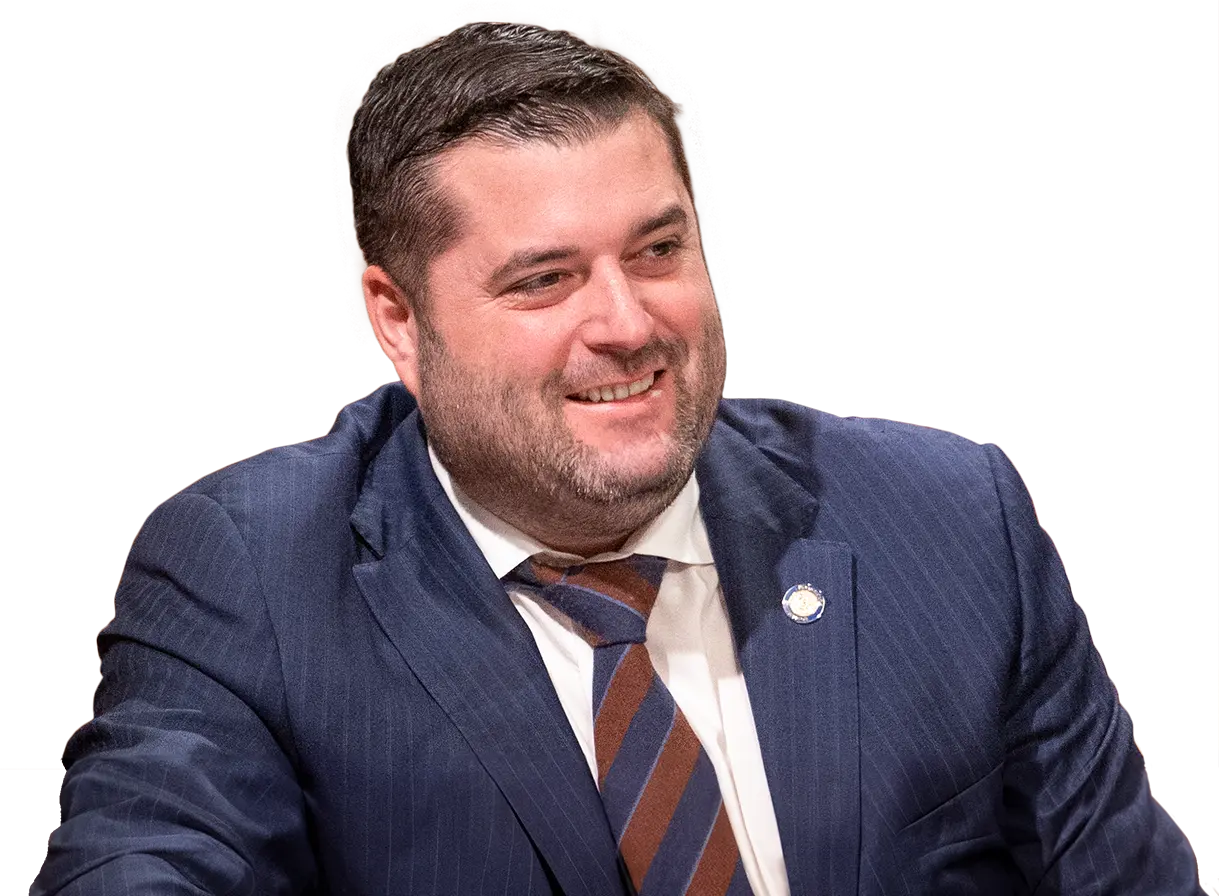

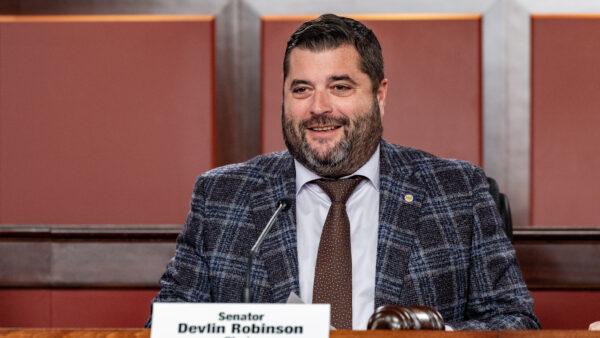
HARRISBURG –– Sen. Devlin Robinson (R-37) is starting the new year by reflecting on a productive 2025 legislative session and announcing bold priorities for 2026 aimed at strengthening Pennsylvania’s workforce, supporting families, and driving economic growth.
“2025 was a year of real progress for Pennsylvania families, workers, and veterans,” Robinson said. “From protecting employees and expanding unemployment benefits to securing millions for local infrastructure and improving support for our veterans, we delivered results that matter.”
2025 Legislative Highlights
Veterans and Military Families
Robinson advanced multiple bipartisan initiatives to honor service members and support veterans. He introduced legislation to increase monthly pension benefits for blind, amputee, and paralyzed veterans, which has advanced from the Senate Veterans Affairs and Emergency Preparedness Committee. He also sponsored legislation modernizing charitable fundraising by allowing electronic payments for veterans’ organizations and other nonprofits, which passed the Senate unanimously.
To expand access to outdoor recreation for veteran rehabilitation, Robinson introduced legislation streamlining hunting and permit requirements for disabled veterans. The bill passed the Senate unanimously and advanced in the House. He also co-sponsored a resolution urging Congress to pass the TREAT PTSD Act to expand access to innovative PTSD treatments.
Labor and Workforce Protections
As Chair of the Senate Labor and Industry Committee, Robinson led bipartisan efforts to prevent unemployment compensation cuts for seasonal workers and secured reforms supporting victims of domestic violence while strengthening the UC system. The bill passed both chambers with strong bipartisan support and was signed into law as Act 55 of 2025.
He supported workforce investments through a $25 million Child Care Worker Retention and Recruitment initiative, now law, and introduced the Family Care Act to support individuals caring for family members. Robinson also sponsored legislation with his Democratic colleagues to allow surviving spouses of fallen Pittsburgh firefighters to retain pension benefits upon remarriage, strengthen worker misclassification enforcement, and improve accessibility standards.
Education and Student Success
Robinson introduced bipartisan legislation prohibiting student cellphone use during the school day, which received unanimous committee approval. He sponsored and led the effort to enact literacy reforms and supported significant education funding increases, including Basic Education, Special Education, Pre-K Counts, Ready to Learn Block Grants, and an expansion of the Educational Improvement Tax Credit program.
He introduced legislation ensuring safe drinking water and clean air in schools, supported cost-of-living adjustments for long-overlooked retired educators and state employees, and applauded the launch of a scholarship program he worked to expand to provide Pennsylvania students pursuing postsecondary education the opportunity to receive financial aid.
Economic Growth and Fiscal Responsibility
Robinson supported a fiscally responsible state budget that avoided tax increases, reduced unnecessary spending, and protected consumers from higher energy costs by preventing participation in the Regional Greenhouse Gas Initiative.
He backed reforms streamlining environmental permitting, continued the phase-down of the Corporate Net Income Tax, preserved net operating loss deductions, and introduced legislation promoting waterfront redevelopment, tourism investment, and energy diversification. He also worked through the Ireland Trade Commission, formed by legislation he sponsored last year, to bring new economic opportunities to Pittsburgh, including a direct flight to Dublin.
Public Safety and Transportation
Robinson secured continued funding for the Western Pennsylvania-based Urban Search and Rescue Task Force, supported tougher penalties for fentanyl dealers, advanced bail reform for dangerous offenders, introduced legislation to update controlled substance scheduling, and backed legislation strengthening opioid enforcement and coordination with federal immigration authorities.
He advocated for reliable public transportation funding, voted to fully fund statewide public transit at $2.6 billion – including $300 million specifically for Pittsburgh Regional Transit (PRT), –sponsored legislation addressing abandoned boats on waterways which became law via passage of the House companion bill, accepted reappointment to the Port of Pittsburgh Commission, and was appointed Vice Chair of the Senate Transportation Committee.
Health Care Access
Robinson co-sponsored and enacted legislation strengthening access to no-cost breast cancer screenings, introduced legislation expanding prostate cancer screening coverage, protected seniors’ access to prescription assistance programs, and introduced legislation expanding addiction recovery support services and opioid overdose awareness.
State Grant Funding Awards
Robinson partnered with his colleagues in the Allegheny County legislative delegation to secure nearly $11.5 million in state grant funding for dozens of important projects throughout the region. This money will be used to fix roads, upgrade sewers, assist EMS agencies, improve municipal services, and much more.
Looking Ahead: 2026 Priorities
Building on last year’s progress, Robinson is advancing several major initiatives in the new legislative session after many conversations with his constituents. One of his priorities is establishing statewide licensing for electricians and electrical contractors, as Pennsylvania remains one of the few states without uniform licensure standards. His forthcoming bill aims to improve safety, ensure quality work, and create reciprocity with other states.
Robinson is also championing legislation to require contractors on public works projects to hire a percentage of their workforce from Pennsylvania or neighboring counties, with a public hearing on the bill scheduled for Jan. 22 in Pittsburgh.
Robinson is also continuing his push to implement a bipartisan bell-to-bell policy prohibiting student cellphone use during school, which received strong bipartisan support in 2025.
Additionally, he is hoping to advance the bipartisan Family Care Act he introduced in 2025, which would create a statewide paid family and medical leave program administered by the Department of Labor and Industry. This program would allow workers to care for loved ones without sacrificing job security or financial stability.
“In 2026, we’re building on last year’s momentum with initiatives that strengthen our workforce, keep jobs local, and provide paid leave for caregivers,” Robinson said. “I would also like to see a long-term, stable plan to fund public transit, and I will continue to be a vocal advocate for recurring revenue that supports a reliable, affordable public transit system. These priorities reflect my commitment to making Pennsylvania a place where people want to live, work, and raise a family.”
Robinson also emphasized his appreciation for his constituents and their communication with him about their thoughts on legislation and policy. “I am glad to have heard from so many constituents in 2025, sharing their comments, concerns, and how I can help,” Robinson said. “I am here to serve them, and they help me do my job better when I know what matters most to them. I’m honored to bring their voices to Harrisburg.”
For a full summary of Robinson’s 2025 legislative accomplishments, visit here.
CONTACT: Stephanie Applegate